


Posted by King K
on August 26, 2026

Status as of 26 August 2026. The Rhode Island Kratom Act, R.I. Gen. Laws chapter 21-28.12, took effect on 1 April 2026 and is in force. Its history of section cites P.L. 2025, ch. 446, section 1 and ch. 447, section 1. The bill that carried it, H5565A, passed the Rhode Island House 40 to 23 on 29 May 2025, sponsored by Speaker Pro Tempore Brian Patrick Kennedy of Westerly, with Senator Hanna Gallo of Cranston carrying the companion S0792. An earlier version cleared both chambers in June 2024 and Governor Dan McKee vetoed it. Licensing under the chapter runs through the Rhode Island Department of Health, not the Department of Revenue, and whether it has actually begun issuing licenses is something we have not confirmed and do not assert. Three states moved in 2026. Rhode Island reopened its market; the other two closed theirs. Tennessee: House Bill 1649 became Public Chapter 950 on 15 May 2026 and took effect on 1 July 2026. North Dakota: Executive Order 2026-04, signed by Governor Kelly Armstrong on 3 August 2026, bars the sale, purchase and possession of kratom and kratom products from 5:00 p.m. on 5 August 2026, with no potency threshold and no fixed end date, and it is in force today alongside a separate threshold based Board of Pharmacy emergency rule, NDAC 61-13-01-03. A special session convenes on 2 September 2026 to consider a statutory framework; no end date for it has been published. New York: S8925A has passed and has not been signed. Rhode Island Current reported on 20 March 2026 that a Portsmouth representative wants kratom kept behind sales counters, so the rulebook described below is the one in force at the date above and it is already being argued over.
Federal position, verified 26 August 2026. DEA's notice of intent of 6 July 2026, at 91 FR 40917, is titled "Schedules of Controlled Substance: Temporary Placement of 7-Hydroxymitragynine Above a Specified Threshold in Schedule I." It is still a proposal. No order has published under it, and the comment period on the threshold was extended to 10 September 2026. A separate temporary scheduling order, document 2026-17429, published on 26 August 2026 at 91 FR 54948 and took effect on publication. It reaches three named derivatives, mitragynine pseudoindoxyl, MGM-15 and MGM-16, and it sets no threshold and no minimum quantity.
Reviewed 26 August 2026. Next review 8 September 2026, or the day North Dakota's special session concludes, whichever comes first.
Federal position, verified 26 August 2026. DEA's notice of intent of 6 July 2026, at 91 FR 40917, is titled "Schedules of Controlled Substance: Temporary Placement of 7-Hydroxymitragynine Above a Specified Threshold in Schedule I." It is still a proposal. No order has published under it, and the comment period on the threshold was extended to 10 September 2026. A separate temporary scheduling order, document 2026-17429, published on 26 August 2026 at 91 FR 54948 and took effect on publication. It reaches three named derivatives, mitragynine pseudoindoxyl, MGM-15 and MGM-16, and it sets no threshold and no minimum quantity.
Reviewed 26 August 2026. Next review 8 September 2026, or the day North Dakota's special session concludes, whichever comes first.
One state has reversed a kratom ban. Rhode Island. It is the only one, it took two legislative attempts with a governor's veto in between, and the thing that finally moved it was not an argument about safety or science. It was money: the second version of the bill carried a licensing and tax mechanism written in coordination with the Department of Revenue, and that is a very different reason for a legislature to say yes than the one the industry had been making for a decade.
What Rhode Island bought with that vote was not an open market. It was a rulebook, and the rulebook is written in numbers. Four of those numbers govern how much mitragynine a product may carry, and how much of a second alkaloid, the one named in the federal notice quoted in the status box above. Call it the named alkaloid. One of the four is the reason this page exists.
Rhode Island caps the named alkaloid at half a milligram per gram of product. Our PRIME Extract Tablet, lot 02122026, sits at roughly twice that. Not a rounding argument, not a labeling problem, and not something we can talk our way out of.
Our own lot, before anybody else's
The disclosure goes first. A reader who finds this page later, works out that we spent two thousand words on other people's compliance problems and buried our own in a footnote, would be entirely right to stop trusting every other number on the site.
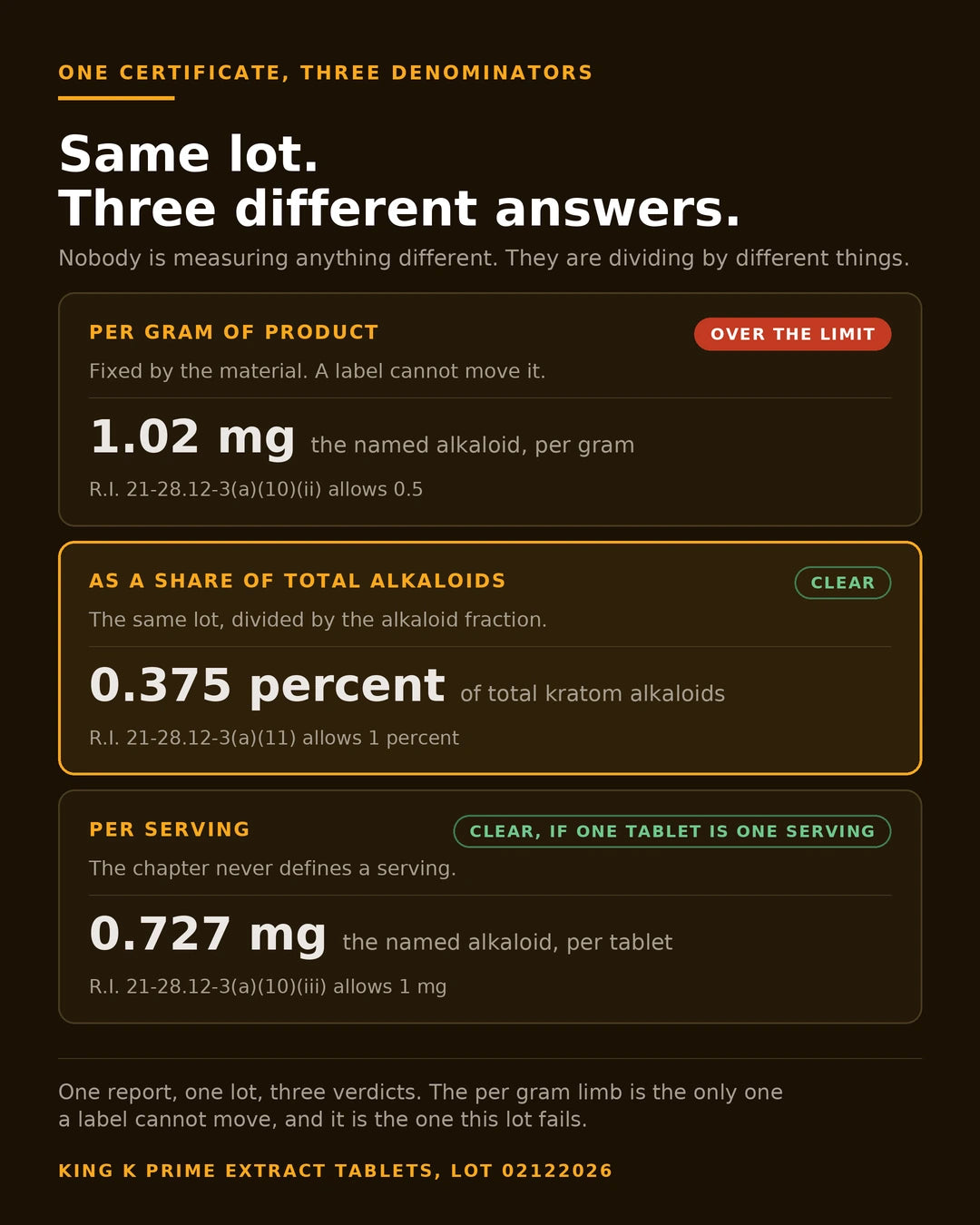
King K's certificate of analysis for PRIME Extract Tablets, lot 02122026, records the named alkaloid at 0.102 w/w%. Rhode Island's limit, at R.I. Gen. Laws 21-28.12-3(a)(10)(ii), is 0.5 milligrams of that alkaloid per gram. A w/w percentage becomes milligrams per gram when you multiply it by ten, so 0.102 percent is 1.02 milligrams per gram. That is a little over twice the Rhode Island line, and under 21-28.12-3(c) a product outside the chapter's limits is contraband.
A gram is a gram. That is the entire reason this particular limb is the finding rather than one of several arguable ones. Serving sizes are a decision somebody makes on a label. Grams are a decision physics makes, and there is no version of that tablet, no repackaging, no revised panel and no more generous reading of the statute in which 1.02 becomes 0.5. The operative text of the chapter is section 21-28.12-3, and the per-gram limb sits in the middle of subsection (a)(10) where almost nobody in the trade press has looked.
That certificate is on our lab results page with the lot number on it. It was published there before this article existed and it is not being published now because a state law made it awkward.
Nor is the lot news here. The fuller answer on reading a certificate, and on why we publish one that failed our own internal specification, is what a certificate of analysis proves, and what it cannot. Go there for the document. Stay here for one number in it, and for what sits underneath that number.
The word Rhode Island forgot to define
Here is where the piece gets more interesting than a simple pass or fail, and where we have to be careful not to overclaim in the other direction.
Subsection (a)(10) of the same section contains four numeric limits, not one. Greater than 150 milligrams of mitragynine per serving. Greater than 0.5 milligrams of the named alkaloid per gram. Greater than 1 milligram of the named alkaloid per serving. And separately, at (a)(11), more than one percent of it as a percentage of total kratom alkaloids. Two of those four are stated per serving.
Now read the definitions section. Section 21-28.12-2 defines fourteen terms: contraband kratom products, department, distributor, importer, kratom, kratom extract, kratom product, licensed, manufacturer, person, place of business, retailer, sale or sell, and synthesized material. Read it twice if you like. "Serving" is not among them.
Our tablet carries 186 milligrams of mitragynine, and Rhode Island's first limb reads 150 milligrams per serving. It would be easy to run that as a second clean failure, and it would make this article punchier and more self-flagellating in a way that reads well. We are not going to, because it is not settled. That comparison holds only if one tablet is one serving, and the statute does not say that a tablet is a serving, does not say a serving is a unit, and does not hand the question to the department either. A manufacturer that declares half a tablet as a serving is reporting 93 milligrams against a 150 milligram ceiling. Whether a Rhode Island regulator would accept that declaration is a real question with real consequences, and the answer is not in the text.
The third limb behaves the same way and happens to fall in our favor, which is exactly why we should say so plainly rather than quietly banking it. Our lot reports 0.727 milligrams of the named alkaloid per tablet against a 1 milligram per serving ceiling. That clears if a tablet is a serving, and it clears by more if a serving is smaller than a tablet. Either way it passes. But notice what that means structurally: a limit written per serving can move when a label moves, and a limit written per gram cannot move at all.
So the honest version of our position is narrower than the dramatic one, and we would rather publish the narrow version. One limb fails on arithmetic that nothing can touch. One limb fails only on an assumption the statute never makes. One passes on any reading. One passes comfortably. That is not the same as "our tablet fails two of four tests", and anybody writing it that way, including anybody writing it about us, is filling a drafting gap with a guess.
Four rulebooks, four tests, one tablet
This is the part worth carrying away from the page, and it has nothing to do with us specifically. The same certificate, unaltered, produces a different verdict in every jurisdiction that has written a rule about that alkaloid, and the disagreement between those jurisdictions is not about the chemistry. It is about what sits underneath the fraction.
| Rulebook | The test | The denominator | Lot 02122026 |
|---|---|---|---|
| Federal DEA notice of intent, a proposal | More than 0.050 percent of the named alkaloid by weight, or more than 1.00 mg of it in the article | Mass of the named alkaloid per mass of product | 0.102 percent by weight. Captured on the percentage limb |
| New York S8925A, passed, not signed | More than 2 percent of total alkaloids, or more than 1 mg per serving | Share of total alkaloids, and mass per serving | 0.375 percent of alkaloids, 0.727 mg. Clear on both limbs |
| Rhode Island 21-28.12-3(a)(10)(ii), in force | More than 0.5 mg of the named alkaloid per gram | Mass of the named alkaloid per mass of product | 1.02 mg per gram. Contraband |
| Rhode Island 21-28.12-3(a)(11), in force | More than 1 percent of total kratom alkaloids | Share of total alkaloids | 0.375 percent. Clear |
Four rulebooks. Four tests. Three denominators, because two of those four tests are secretly the same one.
Work it through. The federal proposal's percentage limb is 0.050 percent of the named alkaloid by weight. Rhode Island's per-gram limb is 0.5 milligrams of the same alkaloid per gram. Half a milligram in a gram is 0.05 grams in a hundred grams, which is 0.050 percent by weight. They are the same concentration written in two different units, and the reason that matters is that a certificate reporting in one unit can look like it answers a rule written in the other when the operator has never actually done the conversion. Our lot reads 0.102 percent, which is 1.02 milligrams per gram, which is a hair over twice both of them at once. One measurement. Two rulebooks. Same failure, twice, in different clothes.
Identical thresholds do not make identical rules, and this is where a careless writer would slide. The federal notice reaches material derived from the named alkaloid that has been further processed to manufacture alternative dosage forms. Rhode Island's chapter does not use that language at all. Its definition of synthesized material reaches any alkaloid created by chemical synthesis or biosynthetic means, expressly including fermentation, recombinant techniques, yeast derived and enzymatic techniques, and it also reaches any alkaloid exposed to chemicals or processes that would confer a structural change. That is a broader net cast at a different shape of thing, and treating the two definitions as interchangeable is how a company convinces itself it has cleared a rule it has not read.
And a rule can have no denominator at all. The temporary scheduling order in the status box reaches three named derivatives with no percentage and no minimum quantity anywhere in it. Nothing to divide, nothing to argue: any detectable amount is the whole test. Different action, different substances, and not the threshold proposal, which is still unfinished. The two get conflated constantly.
The alkaloid-share denominator is the one that flatters concentrates, and it is worth understanding why before anybody leans on it. Our lot reports the named alkaloid at 0.102 w/w% against total Mitragyna alkaloids at 27.2 w/w%. Divide the first by the second and you get 0.375 percent. That clears New York's proposed 2 percent with a great deal of room, and it clears Rhode Island's 1 percent limb, which is half of New York's, with room as well. A product can be extremely concentrated in absolute terms and still show a low fraction of it, because concentrating everything raises the numerator and the denominator together. That is not a loophole anyone smuggled in. It is a deliberate test of whether a product's alkaloid profile looks like leaf, and it answers a genuinely different question from "how much of that alkaloid is in a gram of this".
The rest of the Rhode Island rulebook, which is not mostly about numbers
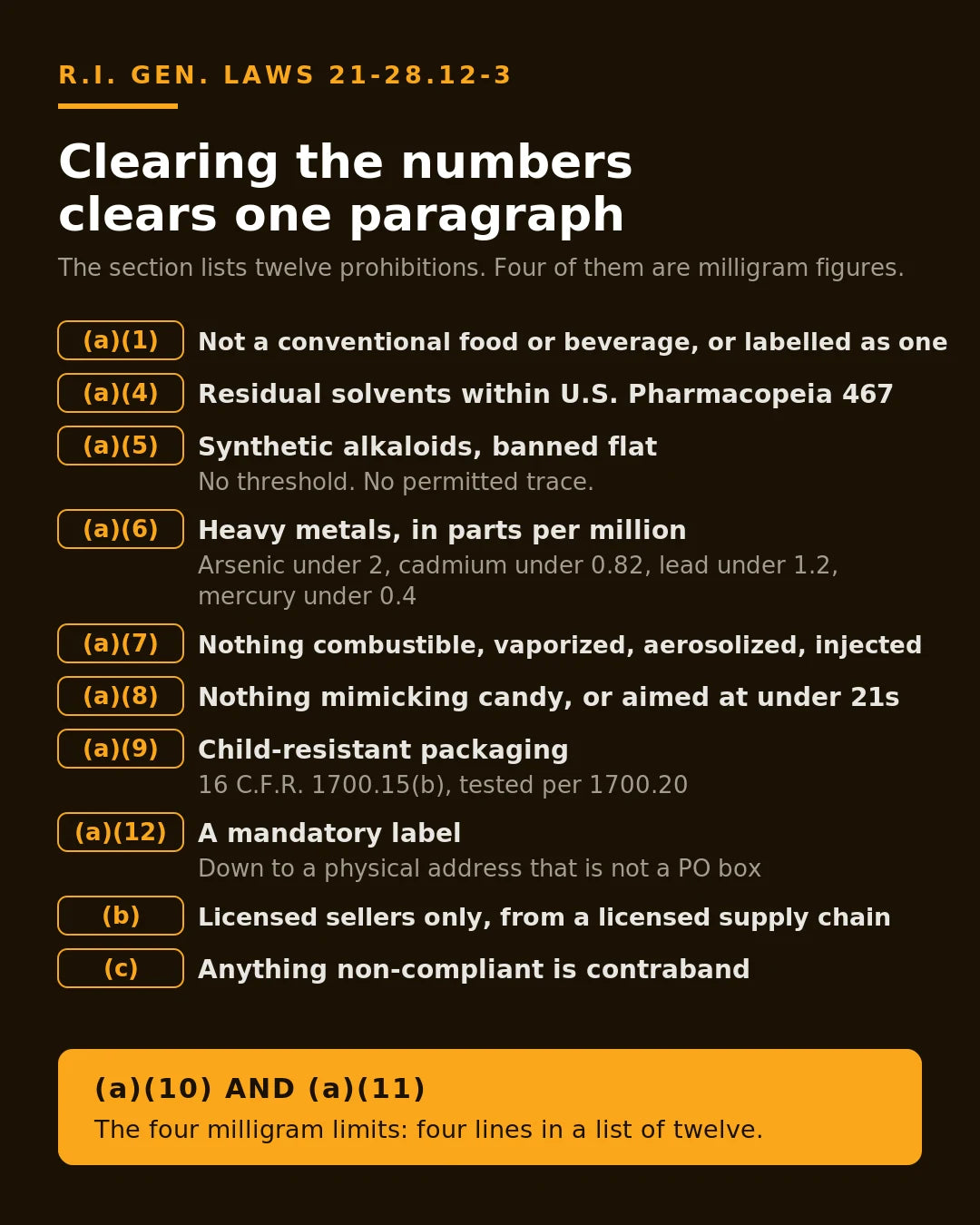
Concentration is the part that gets quoted. It is a small fraction of what section 21-28.12-3 actually prohibits, and an operator reading only the milligram figures would clear them and still be selling contraband.
- Synthetics are banned flat, with no threshold at all. Subsection (a)(5) prohibits any kratom product containing "any synthetic alkaloids including synthetic mitragynine, synthetic 7-hydroxymitragynine, or any other synthetically derived compounds of the kratom plant." There is no permitted trace. There is no percentage to argue about. The language has a live target: trade press reported in July 2025 that the FDA had sent seven warning letters over concentrated products sold as kratom, in tablets, gummies, drink mixes and shots.
- Heavy metals carry stated parts-per-million ceilings. Arsenic below 2, cadmium below 0.82, lead below 1.2, mercury below 0.4. An alkaloid panel does not answer any of those, because it was never asked to.
- Residual solvents may be no higher than U.S. Pharmacopeia 467. For an extract, that is not a formality. It is a question about the process that produced the concentrate.
- Nothing combustible, vaporized, aerosolized or injected. Subsection (a)(7) rules out a whole class of format before any measurement happens.
- Nothing that mimics a candy product or is packaged or advertised so as to appeal to anyone under 21, per (a)(8).
- Child-resistant packaging meeting 16 C.F.R. 1700.15(b) and tested under 1700.20, per (a)(9). That is a specification with a test protocol attached, not a description of a cap.
- No kratom product that is, or is labelled as, a conventional food or beverage, per (a)(1). Format based, not content based, and fatal to an entire category regardless of what its certificate says.
- A mandatory label. Subsection (a)(12) requires a healthcare consultation line, the words that kratom may be habit forming, a pregnancy and breastfeeding warning, a medication interaction warning, the FDA disclaimer, net quantity, mitragynine and the named alkaloid per serving, recommended servings per 24 hours, total mitragynine and the named alkaloid in the product, a store-out-of-reach line, and the manufacturer's physical address, which may not be a PO box.
- Licensed sellers only, sourced only from a licensed manufacturer, importer or distributor, under subsection (b). And under (c), anything non-compliant is contraband.
Behind the prohibitions sits the machinery, and the machinery is the tell. The chapter provides for confiscation of contraband, penalties, a hearing right, an appeal to district court, licensing for manufacturers and importers and distributors and retailers, penalties for unlicensed business, suspension and revocation, taxation of kratom products, and a restricted receipt account to hold the proceeds. Somebody expected this to be enforced and expected it to raise money.
The repeal that worked is the one the industry liked least
Rhode Island Current covered the House floor debate on 29 May 2025, and its account of how the bill finally moved is more useful to an operator than any of the numbers above.
The 2024 version failed on the governor's desk. McKee vetoed it citing regulatory confusion and the advice of state health officials, which is a polite way of saying the health apparatus did not want it. What changed the second time was that the bill added a licensing and tax mechanism in coordination with the Department of Revenue, and Kennedy said so directly on the floor: the state was looking for new sources of revenue, and this would provide one. The bill also grew to twenty-five pages, took input from the Department of Health and from Behavioral Healthcare, Developmental Disabilities and Hospitals, and, by the paper's account, industry advocates bristled at its length, fearing that Kennedy's redux had departed too far from industry goals.
Read that sequence twice if you sell this category. The version the industry preferred got vetoed. The version the industry disliked became the only kratom ban repeal in American history. That is not a coincidence and it is not an insult; it is what a legislature needs before it will reverse itself in public.
The opposition was bipartisan and its arguments were not stupid. Representative Marie Hopkins of Warwick reached for the ephedra and ma huang precedent and said plainly that we do not need a repeat of that. Independent Representative Jon Brien of Woonsocket named the inconsistency that any honest person in this trade has noticed: you cannot vape tutti-frutti, but you could buy some kratom at the gas station and get out in your car and take it right away. Representatives Michelle McGaw of Portsmouth and Chris Paplauskas of Cranston also spoke against. The same Rhode Island Current report described the bill as removing Rhode Island from a list of six states banning outright the sale and manufacture of kratom, and we cite that count the way the paper wrote it, on that date, rather than as a standing figure, because the various lists in circulation are answering different questions and none of them stay still.
And repeal is not an ending. Rhode Island Current reported on 20 March 2026, less than a year into the new regime, that a Portsmouth representative wants kratom locked up behind sales counters. Meanwhile Tennessee went in the opposite direction inside the same twelve months. House Bill 1649 became Public Chapter 950 on 15 May 2026 and took effect on 1 July 2026, after passing the House 78 to 9 on 8 April and the Senate 23 to 2 on 16 April, and we take those roll calls from the legislative record rather than from coverage, because at least one secondary account of that Senate vote is a seat off. Coverage of the act also describes penalties that reach the consumer rather than only the seller. We have not read those penalty grades in the enacted text and will not print one until we have.
Three questions about the denominator
If you buy extracts or tablets, this is the practical residue of everything above, and it is narrower than it looks. Reading the document itself is the subject of the certificate guide and is not repeated here. Once you hold one, three questions are left, and all three are about the denominator.
- Convert the w/w percentage into milligrams per gram. Multiply by ten. A report reading 0.102 percent is 1.02 mg per gram, and a rule written in either unit is now answerable from the same figure.
- Ask which denominator the rule you care about actually uses. Percentage by weight, milligrams per gram, milligrams per serving, milligrams in the article, and share of total alkaloids are five phrasings covering three real measurements, and a seller quoting whichever one flatters the product is telling you something about the seller.
- Separate the numbers that move with a label from the numbers that do not. Anything per serving can be redefined by whoever prints the panel. Anything per gram, or per percentage of weight, cannot be touched at all, which is why the per-gram limb is the one to check first and the one our own lot fails.
If something goes wrong
None of this is a substitute for knowing what to do in an emergency, and a concentrated product deserves a plan. Call 911 if somebody is hard to wake, is not breathing normally, or is unresponsive. Do not wait to see whether it passes. Poison Control is staffed around the clock at 1-800-222-1222, free and confidential, and they will tell you what to watch for.
For dependence, the SAMHSA National Helpline is free, confidential and open 24 hours a day at 1-800-662-4357, with a treatment locator on the same site. To be blunt, because the alternative is letting a comfortable ambiguity sit here: kratom is not a treatment for opioid use disorder. The medicines with an evidence base are buprenorphine, methadone and naltrexone, and a helpline can put you in front of somebody who prescribes them.
Where this leaves us
We sell extracts and pressed tablets, which means that when a state writes a concentration rule, it is writing about us. The only state that has ever repealed a kratom ban wrote one that our own published certificate fails on a limb no amount of relabeling can reach, and we would rather you learn that from us, with the arithmetic shown, than from somebody else with an axe.
What we take from it is a habit rather than a defense. Report in both units. Publish the total alkaloid figure so the fraction can be checked by someone who does not trust us. Say which limb a product clears and which it does not, and say when a comparison depends on an assumption the law has not made. Every certificate we hold, including lot 02122026, sits on the lab results page linked above.
And if you are reading this from a state that has closed its market, we cannot sell to you. King K does not ship kratom where it is prohibited, and our shipping policy is where that list lives. Check it there, not here: three states moved in 2026, and a list printed inside an article is out of date the day the fourth one moves.
Rhode Island proved that a ban can be undone. It also proved what undoing one costs, and the invoice was itemized in milligrams.
This article is general information about state and federal kratom rules and about how laboratory figures are measured. It is not legal advice, medical advice or a purchase recommendation, and it is not a claim that any King K product complies with any current or future rule in any jurisdiction. Laws, proposals and enforcement practice change, and they differ by state and by locality. Verify the current position with qualified counsel and with your state authority before acting on anything here. These statements have not been evaluated by the Food and Drug Administration. This product is not intended to diagnose, treat, cure or prevent any disease. Not for sale to or use by persons under 21.


