


Posted by King K
on August 21, 2026

Status as of 19 August 2026: no federal scheduling order for 7-OH has published. On 6 July 2026 the Drug Enforcement Administration issued a notice of intent at 91 FR 40917 to 40924, proposing to place 7-hydroxymitragynine above a specified threshold into Schedule I. The notice states that the temporary scheduling order "will be published in the Federal Register on or after August 5, 2026". A Federal Register search run on 19 August 2026 returns that notice of intent and no order. So the threshold discussed on this page is a proposal, not law, and 7-OH is not a federally controlled substance at the date of writing. Nothing here is a reason to buy ahead of any rule.
"Lab tested" is the least informative phrase in this category. It appears on packaging, on collection pages and in ad copy, and by itself it commits the seller to nothing at all. A test was performed. That is the entire claim. The document that would settle it has a name, the certificate of analysis, and the phrase never mentions it. Without that report attached, "lab tested" does not say which lab, which lot, which analytes, against which specification, or what the result was, and it certainly does not say what happened when a result came back bad.
Here is the version of the claim that carries weight, and it is the one this page argues for: a lab test is only worth something if you publish it when it fails. Everything else is a sticker.
The number this page is built on
We should get our own exposure out of the way before we say anything about anyone else's, because a reader who finds this later and feels it was buried will be right to stop trusting the rest.
King K's own certificate of analysis for PRIME Extract Tablets, lot 02122026, records 7-hydroxymitragynine at 0.102 w/w%, roughly twice the 0.050 percent figure DEA has proposed as a federal threshold, and the limit test on that same sample is marked FAIL against King K's own internal specification of no more than 400 ppm, at 1,086 ppm.
That report is published on our lab results page. It is dated 20 February 2026, it names the laboratory, and the notes column of its 7-OH limit test carries the word FAIL. We did not have to put it there. We put it there because a page of certificates with no failures on it is not evidence of quality, it is evidence of selective publication, and once a reader works that out every other number on the page becomes worthless to them.
The rest of this guide is about how to read a document like that, including the parts of it that are not flattering to us.
What a certificate of analysis actually proves
A certificate of analysis, usually shortened to COA, is a laboratory's report on one sample. Not one product. Not one brand. One sample, received on a stated date, tested by named methods, with results expressed in stated units against a stated specification.
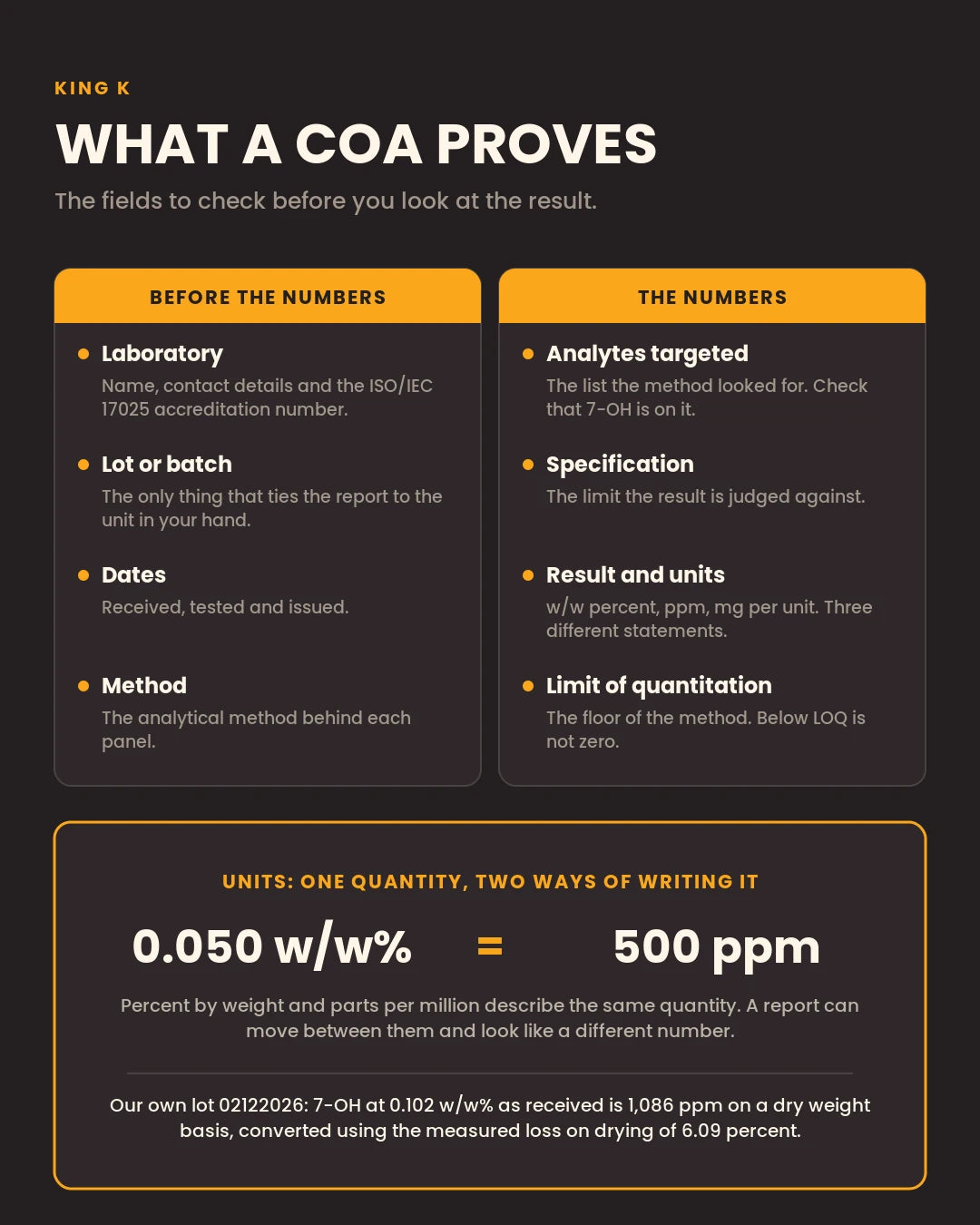
Read the header before you read the numbers. A useful COA tells you the client, the testing facility and its accreditation, the sample name, the lot number, the date it was received, the date it was tested and the date it was issued. Ours says the laboratory is accredited to ISO/IEC 17025:2017 by PJLA under accreditation number 116374, which means an external body has assessed that lab's competence to run the methods it claims. That is worth something. It is not the same as saying the result is good. ISO describes its own standard as a way for laboratories to demonstrate that they operate competently and generate valid results, which is a statement about the laboratory. A2LA, one of the bodies that grants that accreditation, draws the line harder still: accreditation is a formal demonstration of competency to carry out specific conformity assessment tasks such as testing, and it is routinely confused with certification, which attests to something else entirely. Neither is a statement about the tablet.
The footer of the same report says the quiet part plainly: all test articles are analyzed as received, and the results relate only to the specific sample of material or product analyzed. Every honest COA in this industry says a version of that sentence, and almost nobody quotes it in their marketing.
What a certificate of analysis cannot prove
This is where most buyers go wrong, and where most sellers are happy to let them.
A COA cannot prove purity, because purity is not a thing a laboratory measures. What a laboratory measures is the concentration of the specific analytes it was asked to look for, at or above a stated limit of quantitation, using a method chosen in advance. Anything outside that list is not reported as absent. It is simply not reported.
Look at our PRIME tablet report with that in mind. It carries a Mitragyna alkaloid panel by ultra high performance liquid chromatography with diode array detection, a separate 7-OH limit test, and a loss on drying measurement. Three panels. Mitragynine at 26.0 w/w%, or 186 mg per tablet. Total Mitragyna alkaloids at 27.2 w/w%. Loss on drying 6.09 percent. Those are real, useful, checkable numbers, and if you want to know how much mitragynine is in the tablet, the report answers you.
Now ask it a different question. Ask it about lead, cadmium, arsenic or mercury. Ask it about salmonella or E. coli or total yeast and mold. Ask it about pesticide residue, or the residual solvents left behind by whatever process concentrated the alkaloids in the first place. That report does not answer, because it was not asked, and a reader who saw the phrase "lab tested" on the bottle and assumed a clean bill of health has assumed something the document does not say.
Three more things a COA cannot do, and they matter as much as the panel scope:
- It cannot connect itself to the unit in your hand. The link between a certificate and a bottle is the lot number, and only the lot number. If the packaging carries no lot, or the published COA carries no lot, the document is decorative.
- It cannot rule out selective publication. Nothing stops a company from testing five times and posting the friendliest report. The only defense a reader has against that is a seller who publishes the unfriendly ones, which is the whole argument of this page.
- It cannot speak for a later batch. Botanical inputs vary by harvest, by supplier and by process, and a certificate issued in February says nothing whatsoever about material produced in July.
A targeted panel answers only the question it was asked
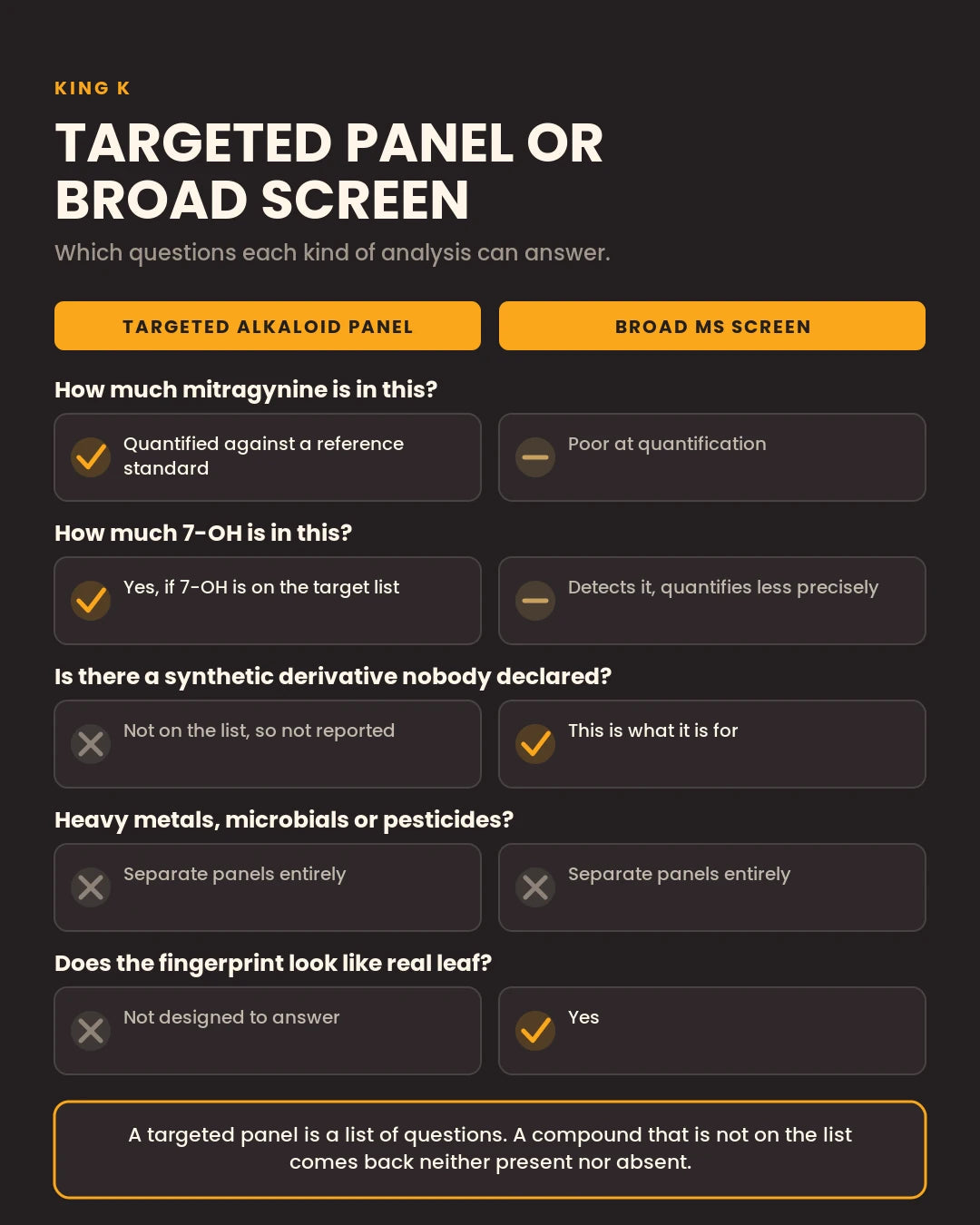
The distinction that matters most to an experienced buyer is between a targeted panel and a broad screen. A targeted panel quantifies a known list of compounds against reference standards. A broad screen, typically by mass spectrometry, looks for what is there rather than for what was expected, and it is the only kind of analysis that can flag a compound nobody thought to specify.
That gap is not academic. It is exactly where this category's worst problems have lived.
| Question | Targeted alkaloid panel | Broad screen |
|---|---|---|
| How much mitragynine is in this? | Yes, quantified against a standard | Poor at quantification |
| How much 7-OH is in this? | Yes, if 7-OH is on the list | Detects, quantifies less precisely |
| Is there a synthetic derivative in here that nobody declared? | No. Not on the list, not reported | This is what it is for |
| Are there heavy metals, microbials or pesticides? | No, those are separate panels entirely | No, also separate panels |
| Does the chromatographic fingerprint look like real leaf? | Not designed to answer | Yes |
DEA's own notice makes the point about undeclared compounds directly. It describes 7-OH products as "often characterized by ambiguous dosages and misleading marketing, frequently being labeled as 'natural M. speciosa extracts'", and notes that evidence shows they may also contain other opioid alkaloids such as mitragynine pseudoindoxyl. The agency then says that essential information regarding their purity, identity, quantity and long term safety remains unknown. You can read the whole thing in the notice of intent at 91 FR 40917, and if you sell or buy concentrates you should.
Reading our failing lot in full, without the spin
Back to lot 02122026, because the detail is instructive and because a number quoted once and then dropped is its own kind of evasion.
Two panels on that certificate report 7-OH, and they report it differently. The alkaloid panel gives 0.102 w/w% as received, and 0.727 mg per tablet, converted using a laboratory measured unit weight of 0.713 grams. The limit test gives 1,086 ppm. Those look like two different measurements and they are not: the report notes that the limit test values are stated on a dry weight basis, converted from the alkaloid panel result using the measured loss on drying of 6.09 percent. Divide 0.102 by 0.9391 and you get 0.1086 percent, which is 1,086 parts per million. Same sample, same instrument run, two bases.
Now set that against the proposed federal language. The DEA notice would capture material derived from Mitragyna speciosa and further processed into alternative dosage forms "such as extracts, concentrates, processed edibles, or pressed pills" where 7-OH is present in amounts greater than 0.050 percentage by weight, or greater than 1.00 milligram of 7-hydroxymitragynine in the article. Note the "or". The two limbs are alternatives, so clearing one of them does not clear the other, and a tablet at 0.727 mg per unit is not rescued by that figure when its concentration reads 0.102 percent. On either basis, as received or dry weight, that lot sits above the proposed percentage line. Pressed pills are named in the text. We are not going to pretend that a rule aimed at pressed tablets was aimed at somebody else's pressed tablets.
What we can say is narrower and, we think, more useful. The proposal has not published as an order. Our internal specification of 400 ppm is stricter than the 0.050 percent figure in the proposal, which is 500 ppm, and that lot missed our number as well as the proposed one. The report saying so is on the site. Whether a finished order lands in the same terms is not something we can tell you, and anyone in this industry who claims to know is guessing.
Why "naturally derived" is not an answer
The reflex defense in this category is that our 7-OH occurs naturally in the leaf, and the problem is the synthetic material. DEA pre-empted that argument in writing, in the same notice, and the wording is not ambiguous:
"Despite the different origins of 7-hydroxymitragynine, the chemical structures of synthetic and naturally occurring 7-hydroxymitragynine are identical. Consequently, the intrinsic pharmacological profile, receptor affinity, and mechanism of action of 7-hydroxymitragynine molecule remain unchanged regardless of its source."
There is a real point buried nearby, and it deserves stating fairly rather than being used as cover. The same passage acknowledges that consumers of raw plant matrix may experience a modified or attenuated effect because of the competing alkaloids that occur alongside 7-OH in the leaf, while isolated or semi-synthetic formulations deliver the target alkaloid unattenuated. That is a genuine distinction between chewing leaf and swallowing an isolate. It is not a distinction between a concentrate above a threshold and a concentrate above a threshold, which is the only comparison that matters once a product has been extracted, concentrated and pressed.
The federal agencies have been explicit that the leaf is treated separately. FDA's 7-OH information hub records that the agencies, by which it means DEA and HHS, stated these actions are intended to target concentrated and synthetic 7-OH products and are not intended to apply to natural kratom leaf containing only naturally occurring trace levels of 7-OH. That is two federal agencies speaking, not a federal and state consensus. That carve-out is about trace levels in leaf. It is not a carve-out for extracts, and reading it as one is how a company talks itself into trouble.
How the category's testing language broke
Some history, because "lab tested" did not become meaningless by accident.
In 2016, Lydecker and colleagues ran a liquid chromatography tandem mass spectrometry method across commercial kratom supplements and found multiple products with 7-OH concentrations substantially higher than raw leaf could account for, concluding that the elevated levels were likely artificial. The paper is indexed on PubMed and FDA cites it. From that 2016 finding to DEA's notice of 6 July 2026, the same failure mode has been described by regulators in the present tense.
The Texas Department of State Health Services warned in September 2025 that semi-synthetic and synthetic 7-OH products reach concentrations of up to 98 percent 7-OH, against natural kratom material where 7-OH is a trace constituent. Its public health alert is one of the clearer state documents on the subject. DEA's notice records a survey of 250 products in which the amount of 7-OH per dose or serving ranged from 1 mg to 700 mg. A seven hundred fold spread, across a shelf where every one of those packages could truthfully carry the words "lab tested".
Enforcement has followed the labeling rather than the chemistry. FDA's June 2025 warning letter to Thang Botanicals is worth reading in full for that reason: declaring 7-OH on the label as a dietary ingredient did not help the firm, because FDA's position is that 7-OH is a new dietary ingredient with no history of marketing before 15 October 1994 and inadequate safety information, which makes the product adulterated. Disclosure is necessary. On its own it is not sufficient, and it is not a defense.
On the harm side, the surveillance data is real and its limits are stated by the people who published it. CDC's MMWR report of 26 March 2026 counted 14,449 kratom exposure reports to poison centers from 2015 to 2025, with 3,434 in 2025 alone, and 233 kratom associated deaths of which 184 involved multiple substances. The same report says its data do not distinguish whether the kratom use involved traditional leaf products or semisynthetic and concentrated formulations. Anyone in this trade quoting those figures to blame a different product format than their own is quoting a document that explicitly declines to make that split.
What to demand before you buy a kratom extract
Treat the phrase as an invitation to ask for the document. If the document does not appear, you have your answer.
- The report itself, not a badge. A PDF or an image of the full certificate, all pages, including the footer notes. A logo that says "lab tested" is marketing.
- A lot number on the report that matches the lot number on the package. This is the single most skipped check and the one that does the most work.
- A named laboratory with an accreditation you can verify. ISO/IEC 17025 with an accreditation number beats an unnamed "third party lab" every time.
- The method and the limit of quantitation. A result of "not detected" means nothing without the LOQ underneath it, because not detected at a high LOQ and not detected at a low LOQ are very different statements.
- The specification next to the result. A number floating on its own cannot pass or fail anything. Ask what the seller's own limit is and whether the result met it.
- 7-OH reported in both units. Percentage by weight and milligrams per serving or per unit. The proposed federal language uses both, and a seller reporting only the flattering one is telling you something.
- The panels that are missing. Ask directly whether heavy metals, microbials, pesticides and residual solvents were run, and on which report. An alkaloid panel is not a safety panel.
- A failure you can point to. Ask the seller when they last published a result that did not meet spec. The answer, or the silence, is the most diagnostic thing you will get.
That last one is uncomfortable to write on our own site, and it should be. We are asking you to hold us to a standard that our own February report did not meet.
If something goes wrong
None of the above is a substitute for knowing what to do in an emergency. Call 911 if someone is difficult to wake, is not breathing normally, or is unresponsive. Poison Control is available at 1-800-222-1222 and at poisonhelp.org, and FDA points readers to that line for suspected adverse events from 7-OH products. Naloxone reverses opioid type respiratory depression, and DEA's own case material records an instance where it was used to reverse a cardiopulmonary arrest involving 7-OH, so having it on hand is sensible for anyone around concentrated products.
For dependence, the SAMHSA National Helpline is free, confidential and open 24 hours a day at 1-800-662-4357, with a treatment locator on the SAMHSA site. To be direct about it: kratom is not a treatment for opioid use disorder or for withdrawal. The medicines with an evidence base behind them are buprenorphine, methadone and naltrexone, and a helpline can point you at a prescriber.
Where this leaves us
We sell extracts and pressed tablets. That is precisely the product category the proposed federal threshold names, and any version of this article that told you the rule was about somebody else would be contradicted by our own lab data one click away. What we can do is publish the numbers, in both units, with the lot and the method and the specification attached, and leave the failures up when they happen.
If you want the underlying chemistry rather than the regulatory framing, our explainer on 7-OH versus mitragynine covers how the two alkaloids differ and why concentration is the axis regulators care about, and kratom extract explained walks through potency labeling. Every certificate we hold sits on the lab results page linked above, including lot 02122026. If you want to see what we currently stock and check each product against its own report before deciding anything, the full range sits in the King K collection.
Read the report before you read the marketing. That is the whole method.
This article is general information about laboratory testing and pending federal rulemaking. It is not legal advice, medical advice or a purchase recommendation, and it is not a claim that any King K product is compliant with any current or future rule. Laws and proposed rules change, and they differ by state and by locality. Verify the current position with qualified counsel and with your state authority before acting. These statements have not been evaluated by the Food and Drug Administration. This product is not intended to diagnose, treat, cure or prevent any disease. Not for sale to persons under 21.


